The Things a Table Knows: Food, Culture & Memory

FROM MY TABLE™
On recipes, rituals, and the quiet inheritance of culture.
"A series of reflections on wine, culture, hospitality, creativity and the art of gathering"

Some recipes have no measurements.
A handful.
A little more.
Enough.
You learn by watching someone's hands.
You learn when the onions turn translucent. When the oil begins to shimmer. When the aroma changes and someone reaches for the next ingredient without looking at a recipe.
You learn that “until it feels right” can be the most precise instruction there is.
I have always loved that kind of knowledge.
The knowledge that lives in the body.
It doesn't announce itself. It is simply there — carried from one kitchen to another, from one pair of hands to the next.
A recipe may never have been written down.
It may not even have a proper name.
Yet someone knows.
And someone else watches.
This is how culture travels.
Quietly.
Through taste and repetition.
Through the things we make so often that we stop thinking of them as knowledge.
A particular way of cutting a mango.
The order in which spices enter a pot.
The food prepared when someone arrives from a long journey.
The dish reserved for a certain celebration.
The thing an aunt makes that nobody else quite gets right.
The measurements that exist only in memory.
Food is rarely only food.
Behind a dish there may be a landscape, a season, a market, a migration, a childhood.
There may be a grandmother.
There may be a story that has been told so many times it has become part of the recipe itself.

I was drawn to the story of chef Bricia López, who returned to her family kitchen in Oaxaca to make sense of the recipes she had grown up with. Her mother had always cooked with “a little bit of this” and “a little bit of that.” So López began measuring, recording and tracing the knowledge behind the food. Her Flavors from Memory and “OaxaCalifornia” is not simply about recipes. It is about ancestors, migration, memory and what happens when a cuisine travels with its people.
That is the thing about food.
A plate is only the visible part.
Behind it may be a landscape.
A season.
A market.
A grandmother.
A journey.
A childhood.
Food rarely travels alone.
It brings music.
It brings language.
It brings colour.
It brings clothing.
It brings ceremony.
It brings the particular mood of a place.
Think of the kitchen before a celebration.
Something is simmering.
Someone is singing.
Someone else is dressed a little differently because today matters.
There are flowers somewhere.
A bottle is waiting to be opened.
The room has a different energy.
Nothing has been formally announced.
Yet everyone knows.
This is an occasion.
We tend to separate these things when we talk about culture.
Food.
Music.
Fashion.
Wine.
But life never did.
They have always been speaking to one another.
A song can belong to a meal.
A dress can belong to a memory.
A wine can belong to a landscape.
A colour can belong to a particular afternoon.
And sometimes, years later, one of those things returns unexpectedly and brings
everything else with it.

A melody begins.
A certain spice hits the air.
You catch a glimpse of red.
A familiar glass catches the light.
And suddenly, you are somewhere else.
The Smithsonian's Pieces of Us: Parallel Plates captures this beautifully through ordinary family stories: an Ecuadorian grandmother's ceviche, a sourdough starter carried across countries, a grandfather's apple cake, a childhood plate of shumai.
The dishes are different.
The stories are not.
Food becomes a thread between where someone came from and where life has taken them.
Memory is rarely tidy.
It does not arrive in chronological order.
It arrives as sensation.
Taste.
Sound.
Scent.
Texture.
Light.
Movement.
That may be why music and food have always felt like such close companions to me.
Both can cross borders without asking permission.
Both can carry the character of a place.
Both can be inherited.
Both can be transformed.
And both can tell you something about who we were before we ever thought to call it history.
There is a particular beauty in watching someone cook from memory.
No measuring cups.
No timer.
Just instinct.
A taste.
A pause.
Another pinch.
A little more heat.
It looks effortless.
It isn't.
Years of knowing are hiding inside the gesture.
The hand knows what the mind no longer needs to explain.
That is the part we risk losing when everything must be written down, standardised, packaged and made repeatable.
We preserve the recipe.
But sometimes lose the person.
The rhythm.
The reason.
The little adjustment that made it theirs.
I think that is why the stories surrounding food matter as much as the food itself.
A dish can tell you who travelled.
Who stayed.
Who adapted.
Who remembered.
Who taught.
Who made something from very little and turned it into something everyone wanted to
return to.

The National Museum of African American History and Culture's exploration of Black foodways is a powerful reminder of this. Planting knowledge, cooking techniques, ancestral recipes and memories travelled with Africans across the Atlantic, then met new landscapes, ingredients and communities.
The food changed.
The history did too.
But the knowledge kept moving.
That is the beautiful tension of inheritance.
You receive something.
You carry it.
And one day, you add something of your own.
The next person receives that.
And the story continues.
Not unchanged.
Not untouched.
Alive.

I have always been drawn to that space between inheritance and invention.
It is where culture becomes creative.
Where an old rhythm finds a new arrangement.
Where a familiar fabric becomes a new silhouette.
Where a recipe moves across a border and acquires another accent.
Where a bottle of wine carries one landscape into another.
Where something ancient can still feel completely of the moment.
A table understands this instinctively.
It does not demand purity.
It simply makes room.
For what came before.
For what is here now.
For what might come next.
And perhaps that is why a table can hold so much without looking as though it is holding anything at all.
The food.
The wine.
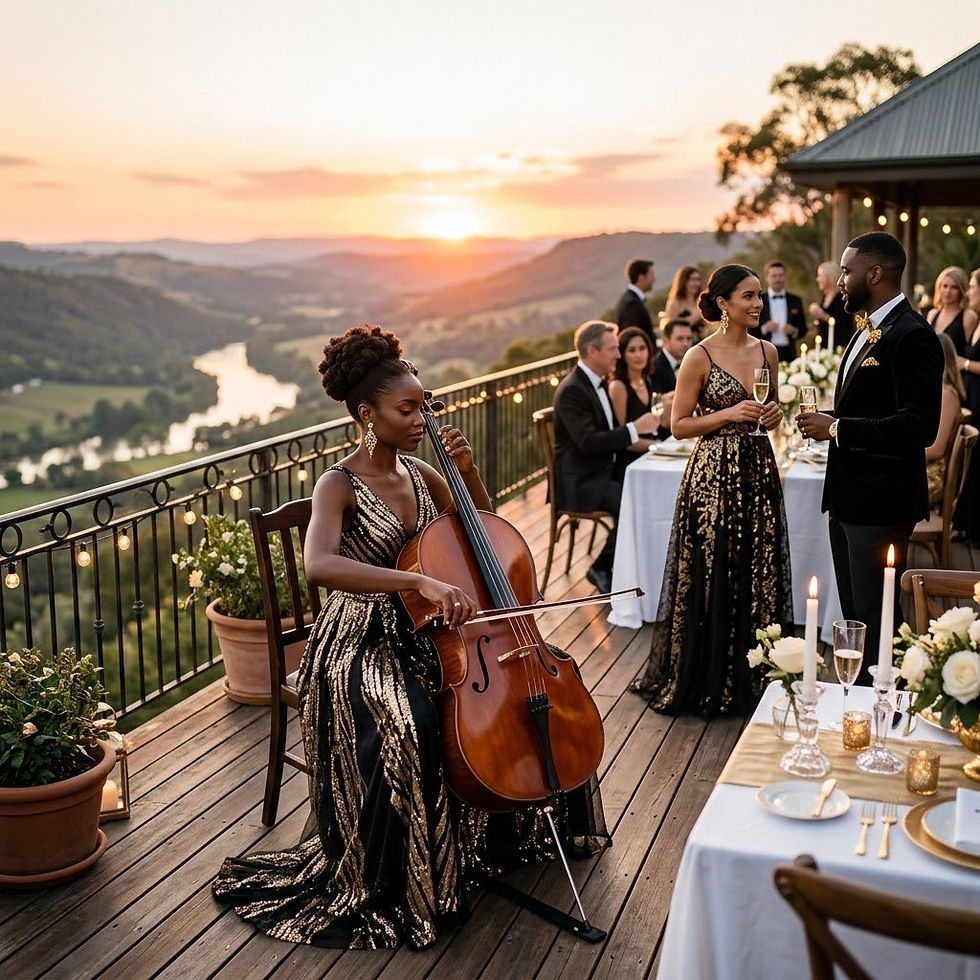
The music.
The clothes.
The flowers.
The weather.
The landscape beyond it.
The people who arrived carrying one version of themselves and leave carrying another.
Sometimes nothing particularly remarkable happens.
The sun shines.
The roses bloom.
A song plays from somewhere nearby.
Someone pours another glass.
The mountains sit quietly in the distance.
And for a moment, everything is exactly where it should be.
Those moments are easy to overlook.
We shouldn't.
Because culture is not only what survives in museums.
It is what survives in us.
In our hands.
In our taste.
In our rhythm.
In what we choose to wear.
In what we choose to play.
In what we choose to pour.
In what we choose to make again.
And then, inevitably, to make differently.

Not everything we inherit arrives in a box.
Some of it arrives in a bowl.
Some in a bottle.
Some in a melody.
Some in a piece of cloth.
Some in the way someone dresses a table.
Some in the smell of something cooking before the front door has even opened.
And some of it arrives in the words:
“Watch me. I'll show you.”
There is an entire education inside that sentence.
Someone showing someone else how.
No classroom.
No certificate.
No applause.
Just attention.
Repetition.
Time.
Love.
The next time you sit at a table, look a little closer.
Listen to what is playing.
Notice what people are wearing.
Look at the flowers.
Notice the light.
Taste what is in your glass.
Ask where the food came from.
Ask who taught the person who made it.
Ask what has changed.
Ask what has stayed.
You may discover that the meal in front of you is carrying much more than flavour.
It may be carrying a language.
A landscape.
A family.
A migration.
A memory.
A piece of a culture still being made.
Some things are written in books.
Others are written into our hands.
And some of the oldest stories in the world are still being passed around the table.

From My Table Notes
📍 Written from: Johannesburg, South Africa
🍷 In My Glass: Catena Zapata 'Angelica Zapata Alta' Malbec
🎵 Soundtrack: Calderón — Grupo Niche
👗 Dress Code: Code Red
🕯 On the Table: Red roses in bloom. Something warm from the kitchen. A bottle catching the afternoon light.
🌙 Mood: Alive.
💭 Reflection: Some memories arrive as stories. Others arrive as a song, a colour, a taste — and suddenly, you are somewhere else entirely.
Inspired By
Flavors from Memory and “OaxaCalifornia”: The Cookbooks of Bricia Lopez — Smithsonian InstitutionA story of recipes, ancestors, migration and the living knowledge carried through family food.
Pieces of Us: Parallel Plates — Smithsonian Center for Folklife and Cultural HeritagePersonal stories of the dishes, recipes and food rituals that become part of family identity.
Black Foodways and Cuisine — National Museum of African American History & CultureStories tracing African culinary knowledge, migration, adaptation and memory through food.
Foodways — Smithsonian Center for Folklife and Cultural HeritageA wider collection of stories exploring food, migration, celebrations, family traditions and cultural transmission.
Stay a Little Longer...
🍷 Discover Wine Wisdom & Wonders™An invitation to explore wine through story, culture and sensory experience.
🌍 Explore Vine to Soul™ through Liz Ogumbo Wines™Where wine, travel, culture and meaningful experiences meet.
🎵 Listen to KenSoul™The soundtrack to the stories, tables and journeys shared here.
👗 Discover Liz Ogumbo Fashion™ & DeniMania™Fashion as storytelling, circular innovation and cultural expression.
📸 Browse the From My Table™ Journal ArchiveA growing collection of reflections on wine, hospitality, music, fashion and the art of gathering.
“Some things are written in books. Others are written into our hands.”
Sip with Wisdom. Live with Wonder.
—


Comments